
Why is Container Storage Optimization Crucial Nowadays
Demand for High-Density Storage in Industrial Yards is Constantly Increasing
With the continuous operation of the global supply chain, the container throughput in the industrial sector has been rising year by year. Traditional flat storage methods can no longer meet the demands. Enterprises need to enhance the utilization rate of the yard through high-density storage. Container storage optimization has gradually become a core issue in the operation of industrial yards, directly related to operational efficiency and cost control.
Limited Space for Expansion due to Rising Land Costs
The scarcity of industrial land has become more prominent, and the costs of leasing and purchasing land have been increasing year by year. Most yards are located near industrial parks or transportation hubs, making large-scale horizontal expansion impossible. Even if expansion is feasible, the high costs and cumbersome approval processes deter enterprises. Optimizing storage methods and tapping into the potential of existing space have become key to reducing costs and improving efficiency.
Operational Inefficiencies Caused by Traditional Equipment
In the past, industrial yards commonly used traditional equipment such as forklifts and truck cranes. Forklifts have limited working height and range, resulting in low space utilization. Truck cranes are complex to operate and not very efficient, unable to meet the demands of frequent handling. These limitations lead to congestion in the yard, slow container turnover, and wasted space. Container straddle carriers, which can balance space utilization, operational flexibility, and efficiency, have become the ideal solution.
What is a Container Straddle Carrier
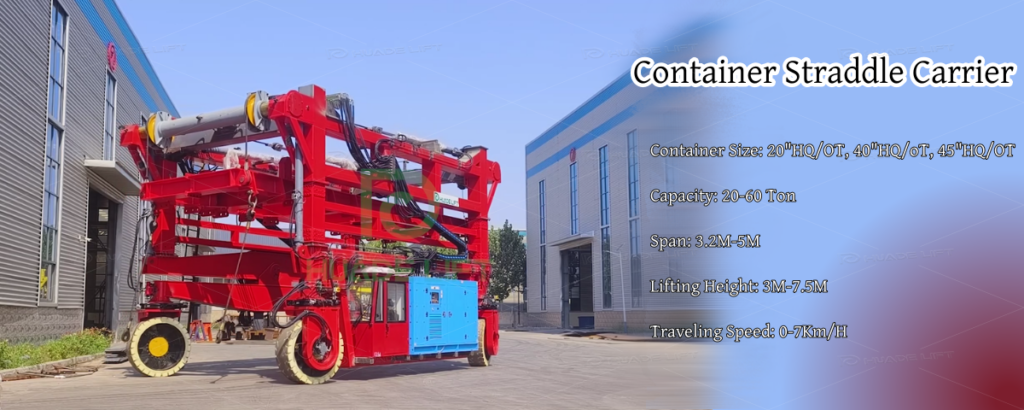
A container straddle carrier is a heavy-duty vehicle mainly used in industrial storage yards and logistics hubs, responsible for transporting and stacking containers. Its unique structure enables it to “sit” on top of the containers, lifting them from the top and achieving efficient short-to-medium distance transportation. It integrates the lifting and transportation functions into one, allowing the entire process to be completed without the need for auxiliary equipment, meeting the high-density and flexible operation requirements of various industrial storage yards.
Core Functional Features
Adapts to Various Standard Container Sizes
The sizes of containers in industrial storage yards vary. The container straddle carrier can flexibly adapt to common standard sizes and complete the transportation and stacking of containers of different sizes without adjusting the equipment, meeting the temporary and long-term storage needs of various storage yards, avoiding the inconvenience caused by insufficient equipment adaptation.
Integrates Lifting and Transportation Functions
Traditional equipment requires division of labor to complete lifting and transportation, with a cumbersome process and poor connection. The container straddle carrier integrates the two functions, allowing one device to complete the entire process of picking up, transporting, and stacking, reducing operation links and labor input, shortening operation waiting time, and improving continuity.
Supports High-density Stacking
High-density stacking is the core requirement for storage optimization. The container straddle carrier can achieve multi-layer stacking configuration, making full use of vertical space, breaking the limitations of traditional equipment’s low-level stacking, and significantly increasing storage capacity without expanding the lateral area, especially suitable for storage yards with tight land and high storage pressure.
No Track Dependence, Strong Maneuverability
The container straddle carrier adopts a rubber tire design, allowing free movement without tracks, and can operate in any area of the storage yard, adapting to different layouts and temporary adjustment of operation areas. Its moderate turning radius enables flexible driving in narrow passages, further improving space utilization.
HuadeLift container straddle carrier is more suitable for the actual needs of industrial storage yards in terms of maneuverability design. The optimized tire configuration and steering system can enable flexible navigation in complex storage yard environments, even when facing temporary adjustment of operation routes, it can efficiently complete tasks and help with storage optimization.
Container Storage Optimization in Industrial Applications
Core Objective of Storage Optimization
Maximizing Stacking Density
Stacking density is the core indicator for measuring the storage efficiency of the container yard. Maximizing stacking density means storing more containers within the limited land area, reducing space waste. This requires the use of appropriate equipment and scientific layout, fully utilizing vertical space and reducing the unit storage cost of containers.
Reducing Secondary Handling of Containers
Secondary handling is an inefficient process, which increases costs and prolongs turnover time. Storage optimization needs to reasonably plan the storage locations of containers, storing them according to the inbound time, outbound demand, and type of goods, ensuring that subsequent outbounds can directly obtain the goods without additional handling and adjustment.
Improving Throughput and Turnover Efficiency
The throughput and turnover efficiency of the storage yard directly affect the operational efficiency. The ultimate goal of storage optimization is to enhance the efficiency of the entire process of inbound, storage, and outbound of containers by rationally arranging the layout and using efficient equipment, thereby reducing congestion, shortening operation time, avoiding container backlog, and improving service quality.
Core Challenges of Industrial Storage Yards
Limited Ground Space
Most industrial storage yards have a small area and are located in urban areas or industrial parks. The land is scarce, and traditional flat storage cannot meet the demand. Moreover, operation channels and equipment parking areas need to be reserved, further reducing the storage space. How to efficiently utilize the limited space becomes the primary challenge.
Mixed Cargo Types
The cargo types in industrial storage yards are complex. Besides standard containers, large equipment and oversized components are also often stored. These goods have different sizes and weights, and different storage requirements. Some oversized components cannot be stacked, and the stacking height of different weight containers needs to be strictly controlled, increasing the complexity of storage optimization.
Dynamic Changes in Storage Yard Layout
Many industrial storage yards have project-oriented operations. As the project progresses, the storage demand and layout will be constantly adjusted. Traditional fixed layouts and equipment are difficult to adapt to this dynamic change, which may lead to inefficient operations and space waste. It is required that the storage yard have strong flexibility.
How to Enhance Storage Efficiency with Container Straddle Carrier
Container Straddle Carrier for High-Density Stacking
The core advantage of container straddle carrier is their high-density stacking capability, which enables multi-layer stacking and makes full use of vertical space. It breaks the limitations of traditional equipment’s low-layer stacking and can significantly increase storage capacity without expanding the lateral area, effectively solving the problem of insufficient storage space and maximizing the value of limited land.
Container Straddle Carrier for Flexible Yard Mobility
Rubber Tire Design for Flexible Movement
The rubber tire design allows container forklifts to move freely without tracks, breaking the layout restrictions of track equipment and making the operation range more flexible. They can quickly reach any operation area without damaging the containers or the ground, and have good shock absorption effects, reducing damage.
Adapt to Temporary or Dynamic Operation Scenarios
Industrial yard operations are often dynamic, especially in project-oriented yards where the layout changes as the project progresses. The container straddle carrier’s no-track design allows it to adapt to new layouts without renovation, ensuring continuous operations, improving efficiency, and avoiding operation interruptions.
HuadeLift container straddle carrier, in line with the dynamic operation characteristics of industrial yards, optimize the power system and control performance, enabling rapid response in temporarily adjusted operation areas, maintaining an efficient working state, and further enhancing storage efficiency.
Container Straddle Carrier for Faster Container Throughput
Directly Obtain Stacked Containers
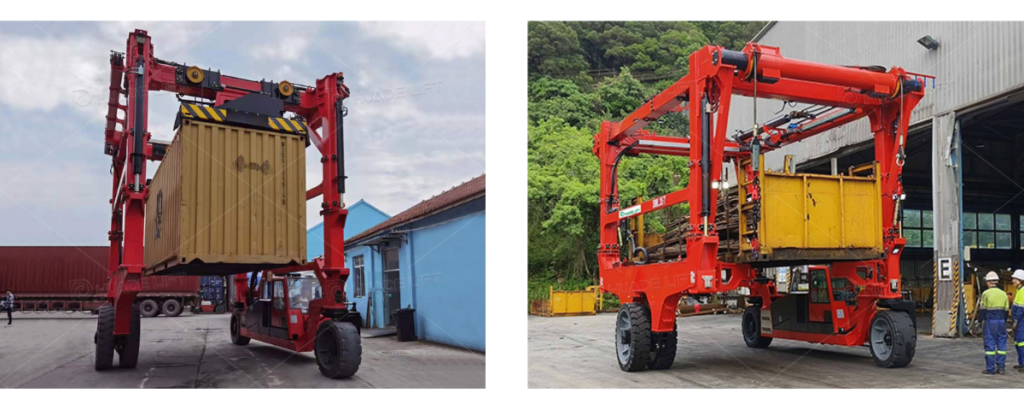
When traditional equipment retrieves containers from lower or middle layers, it needs to move the upper layer containers for secondary handling, which is time-consuming and labor-intensive. Container straddle carrier can directly lift containers from the top without moving other containers, reducing secondary handling, shortening operation time, and improving turnover efficiency.
Reduce Idle Time to Improve Operational Continuity
After reducing secondary handling, operators do not need to switch between equipment or wait for auxiliary operations, enabling continuous operations, making the entire container process smoother, avoiding congestion and waiting, and further enhancing overall operational efficiency and turnover speed.
Flexible adaptation to yard layout, meeting dynamic demands
Industrial yard layouts need to be adjusted according to operational requirements and project progress. Traditional equipment is difficult to adapt. Container straddle carrier have strong layout adaptability, can flexibly divide storage areas, and can quickly adapt to new layouts without equipment renovation, ensuring continuous operations, helping yards optimize layouts and improve space utilization.
Typical Storage Layout Using Container Straddle Carriers
Block Stacking Layout (High Density)
The block stacking layout focuses on high-density storage and is suitable for long-term storage scenarios of containers. Containers are stacked in blocks to fully utilize vertical space and maximize storage capacity. It is suitable for long-term storage of goods such as energy storage (BESS) containers, facilitating unified management and maintenance, enhancing safety, maximizing land utilization, and being compatible with land-constrained storage yards. It perfectly matches the stacking capabilities of container straddle carriers.
Flow Layout (High Throughput)
The flow layout is suitable for scenarios with high frequency of container entries and exits. By reasonably planning inbound channels, storage areas, and outbound channels, it avoids cross congestion. The stacking height is adjusted according to the outbound frequency to ensure quick access. Container straddle carriers have strong maneuverability and can flexibly move through the layout, improving throughput and turnover efficiency, and ensuring smooth operations for frequent entries and exits.
Mixed Layout (Adapted to Mixed Goods)
The mixed layout is suitable for storage yards with mixed types of goods. Areas are divided according to the type of goods and storage requirements. Container areas are stacked in high density, and oversized components are stored flat. This balances different needs and improves space utilization. It is highly flexible and can adjust areas according to changes in goods. Container straddle carriers can adapt to complex layouts, complete container operations, and assist with oversized component operations in coordination with other equipment.
Applications of Container Straddle Carriers Outside Ports
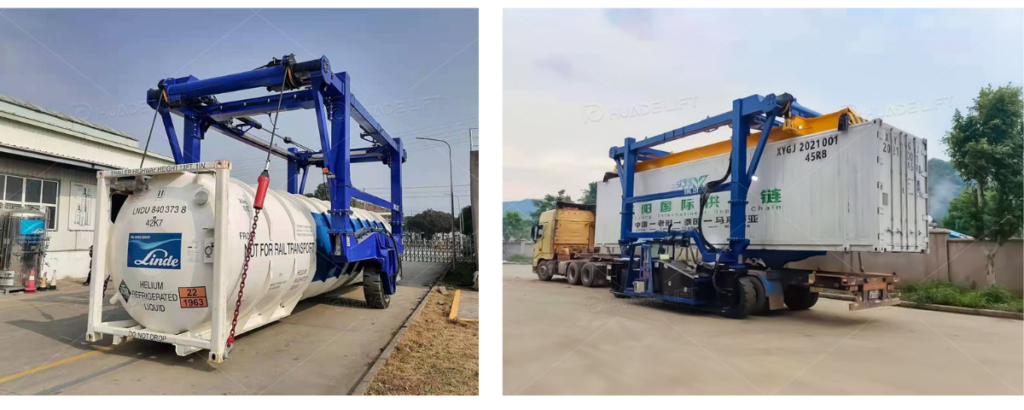
Modular Buildings and Prefabricated Component Storage Yards
Most prefabricated components for modular buildings are designed in a container format and require centralized storage and turnover. The project progress demands high efficiency in storage and transportation.
Container straddle carriers can increase storage capacity through high-density stacking, quickly complete transportation and turnover with flexibility, supply components in line with the project schedule, and flexibly adjust storage areas to achieve precise management of components.
Storage Scenarios for Wind Power Equipment
The storage of equipment in wind power projects is crucial. Large components and parts such as blades and towers need centralized management. The layout of the storage yard is complex and the demand is dynamic.
Container straddle carriers, without track design and flexibility, can operate freely in complex environments. Their lifting capacity is suitable for different weight containers, ensuring the safe transportation and storage of components, and facilitating project progress.
Storage Scenarios for Energy Storage Systems (BESS)
Energy storage containers are standardized and highly mobile. Storage requires balancing safety and efficiency, and demands high-density stacking and convenient access. Container straddle carriers’ high-density stacking ability can increase storage capacity, reduce waste, and directly access for quick turnover. Precise control ensures stacking safety and avoids damage to containers.
Storage Yards for Steel Structures and Processing Factories
Steel structure processing yards need to store steel, components, and supporting containers. The goods vary greatly, the layout is complex, and the process is cumbersome. Container straddle carriers can flexibly adjust operation methods to complete container transportation and stacking, assist in the operation of steel structure components with other equipment, optimize layout, reduce waste, improve efficiency, and reduce costs.
Comparison Between Container Straddle Carriers and Other Storage Equipment
Compared with Forklifts
Forklifts have limited working height and range, resulting in low space utilization and low operational efficiency; container straddle carriers have a high stacking height, a simple operation process, and higher efficiency.
Compared with Rubber Tyred Gantry Cranes
Rubber tyred gantry cranes are track-based, with a fixed layout and poor flexibility, and there are operation blind areas; container straddle carriers have no track constraints, strong flexibility, and a wide operation range, and can quickly adapt to layout adjustments.
Compared with Gantry Cranes
Gantry cranes have limited operation range and stacking height; container straddle carriers have a wide operation coverage and high stacking efficiency, and can operate freely without frequent equipment adjustment.
Key Factors for Choosing a Container Straddle Carrier
Lifting Capacity and Stacking Height
Lifting capacity and stacking height directly affect storage capacity and operational efficiency. They need to be selected based on the weight of the containers in the storage yard and the storage requirements. At the same time, the stability of the lifting must be considered to ensure the safety of stacking and avoid accidents.
Adaptability of Yard Size and Layout
It is necessary to combine the width of the storage yard’s passageways to select equipment with appropriate turning radii to ensure flexible passage and avoid congestion; at the same time, the size of the equipment and the width of the passageways should be matched to balance the flexibility of passage and operational capacity, and meet the actual operational needs.
Power Type: Comparison between Diesel and Electric
Scenarios with high environmental protection requirements are suitable for electric straddle carriers, which have zero emissions and low noise; in remote areas or scenarios with inconvenient charging, diesel power is suitable, with strong range and convenient refueling.
In terms of operating costs, electric equipment has lower electricity and maintenance costs, while diesel equipment has higher fuel and maintenance costs. The choice should be made based on the scenario and financial situation.
Automation and Intelligent Functions
Remote operation allows operators to work in a safe area, improving safety; semi-automatic functions can simplify processes, reduce labor intensity and human errors, and improve efficiency and accuracy; integration with the yard management system can achieve real-time data transmission and refined management, further enhancing operational levels.
Key Considerations for Installing Container Straddle Carriers
Pre-installation Equipment Inspection
Before installation, a comprehensive inspection of all components is required, with a particular focus on vulnerable parts such as the structure, lifting mechanism, and tires. Ensure there is no transportation damage, that all connection components are complete and securely fastened. Compare and verify against the manual and parts list to ensure there are no omissions, and guarantee the equipment is installed and operated normally.
Precise Alignment During Assembly
Assembly must be carried out strictly in accordance with the manufacturer’s alignment specifications. Use professional tools to ensure precise positioning and alignment of each structural component to avoid misalignment and deviation. Prevent uneven force on the equipment during operation, component wear or failure, and ensure stable operation and extended service life.
Integrity Check of the Hydraulic System
The hydraulic system directly affects the equipment’s operational performance and safety. Check for no leakage or damage to seals and connection joints, ensure the hydraulic oil level is within the recommended range, test the hydraulic system response, and ensure there is no abnormal noise, stable pressure, and avoid operational downtime.
Comprehensive Function Testing and Debugging
After assembly, test the basic functions such as starting, moving, turning, and braking, as well as core functions such as lifting, stacking, and transportation. Simulate actual scenarios to check the operation status, test the load capacity, promptly adjust and repair any issues found, and finally perform system calibration to ensure safe operation.
Conclusion
In the optimization of container storage in industrial storage yards, container straddle carrier, with their advantages of high-density stacking, flexibility and mobility, and integrated operations, have become the core equipment for solving storage problems and improving efficiency.
Enterprises need to select appropriate equipment based on their own needs. HuadeLift provides targeted solutions with practical designs, helping enterprises enhance their competitiveness. In the future, its performance and intelligence will continue to improve.
