
Understanding Steel Coil Handling Requirements
Core Requirements and Handling Challenges of Steel Coils
Steel coils, as the core products of steel production, are widely used in industries such as automotive manufacturing and mechanical processing. The core requirements for lifting, positioning, and load control are stability and accuracy. Steel coils are heavy, have a smooth cylindrical shape, and it is difficult to form a stable gripping interface. Moreover, there are significant differences in specifications, requiring high system adaptability and multi-scenario compatibility.
Requirements for Steel Coil Storage and Core Challenges in Handling
Steel coils can be stored both indoors and outdoors. Outdoor storage requires consideration of environmental factors such as wind, rain, and dust. Most of them are stored in rows or on shelves, and the handling equipment must be able to flexibly adapt to different layouts to achieve efficient stacking and retrieval.
The core challenge of steel coil lifting and transport operations is to balance weight, precision, and cycle time efficiency. Therefore, the crane must be sufficiently load stability, structural rigidity, and adaptable configurations, and equipped with dedicated lifting tools to ensure a secure and non-damaging grasp of the steel coils.
The Challenges of Handling Steel Materials
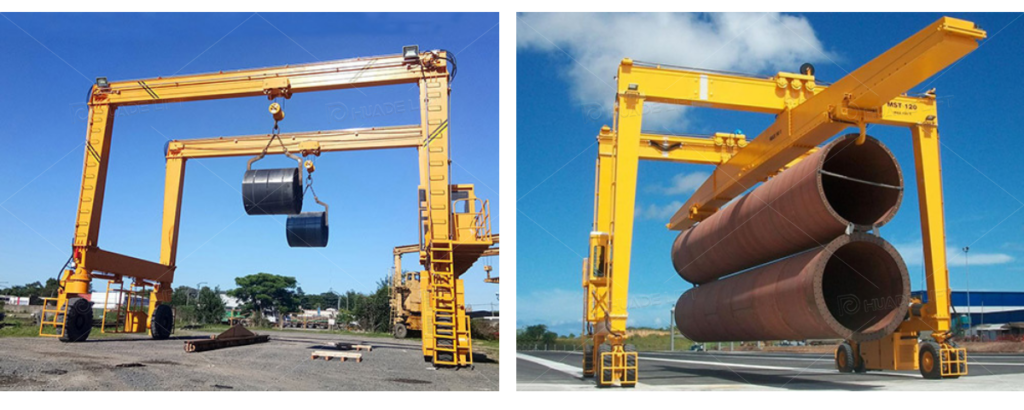
The shapes of steel materials vary, and the difficulties in handling vary accordingly. Steel coils, due to their circular structure and smooth surface, are prone to slippage during lifting and positioning, requiring extremely high load-bearing capacity and anti-sway performance. Special lifting tools are needed; Steel plates are wide and flat, and improper support can cause bending; Steel beams and steel tubes are long and strip-shaped, making balance difficult; Steel scraps and steel ingots have irregular shapes, making grasping challenging.
Traditional handling equipment has obvious limitations, either lacking mobility or having insufficient span or carrying capacity, making it difficult to meet the multi-scenario requirements of large steel warehouses. Rubber tyred gantry cranes (RTG) with their unique structure and flexibility can adapt to various steel handling, especially showing an irreplaceable advantage in steel coil handling, becoming one of the mainstream equipment.
Understanding Rubber Tyred Gantry Cranes
Core Structure and Mobility Characteristics
Rubber tyred gantry cranes use rubber tires as the walking components, breaking free from the constraints of tracks, and have greater mobility. They can freely move on ordinary concrete surfaces and provide high maneuverability and layout adaptability according to operational needs, adapting to different warehouse layouts.
Power Sources and Structural Classification
The power sources of rubber tyred gantry include diesel, electricity, and hybrid power. Diesel-driven has strong mobility and is suitable for outdoor or temporary warehouses without stable power supply;
Electric-driven has low energy consumption and is environmentally friendly, suitable for indoor stable power supply scenarios;
Hybrid power combines mobility and environmental protection and is currently the mainstream choice.
Structurally, they are divided into single beams and double beams. The double beam has stronger bearing capacity and is more suitable for handling heavy materials such as steel coils.
Application Scenarios and Core Advantages
Rubber tyred gantry crane was initially used for container handling in ports and has gradually been promoted to steel plants and steel warehouses. Compared with traditional cranes, its core advantages are flexibility and versatility, being able to adapt to the dynamic adjustment requirements of steel coil storage locations without large-scale modifications to the warehouse layout, significantly improving operational efficiency.
Why Rubber Tyred Gantry Cranes Are Ideal for Handling Steel
Rubber tired gantry crane can become an ideal equipment for steel coil handling because its performance precisely matches the requirements, effectively addressing the pain points of traditional equipment, and improving operational safety and convenience.
Flexible Movement and Adaptable to Multiple Layout Scenarios
The mobility and maneuverability are outstanding. Due to being free from track constraints, there are no track limitations.They can freely shuttle on flat concrete surfaces indoors and outdoors, enabling rapid task switching across multiple operation zones.They flexibly adapt to irregular warehouse layouts, easily reaching corners of the warehouse that conventional equipment cannot reach.
This effectively reduces the restrictions of warehouse layouts on operations, further improving warehouse space utilization and throughput, and meeting the operational requirements of scattered steel coil storage.
Strong Bearing Capacity and Adaptable to Various Steel Coils
It has high load-bearing performance and can stably carry various specifications of steel coils, fully adapting to the handling requirements of different weights and sizes of steel coils.
The double beam model has more prominent bearing performance and can easily handle heavy steel coils. In long-term and high-intensity steel coil handling operations, the scientific structural design can effectively distribute the concentrated load of the steel coils.
This reduces component fatigue and structural wear of the equipment, thereby extending the overall service life of the equipment and reducing the operating costs of the enterprise.
Customized Hoisting Devices, Balancing Safety and Efficiency
The hoisting devices can be customized, and specific hoisting devices (such as C-shaped hooks, steel coil clamps) can be selected according to the characteristics of the steel coils to ensure secure gripping and surface protection.
HuadeLift, for the steel coil handling scenarios, provides customized hoisting devices for rubber tired gantry crane, which can be flexibly adjusted according to the specifications of the steel coils, balancing stability and surface protection. They are made of high-strength materials, wear-resistant, durable, and easy to replace, effectively improving handling throughput and workflow efficiency.
Multi-purpose Use, Precise and Stable Operation
Rubber tired gantry cranes have strong versatility and can be equipped with lifting beams, magnetic lifting devices, etc., to flexibly handle steel plates, steel beams, etc., enabling multi-application handling and higher asset utilization, reducing the investment in dedicated equipment, and lowering the operating costs of the enterprise.
At the same time, it is equipped with advanced control technologies such as variable frequency speed regulation and anti-shaking, which can achieve precise motion control and positioning accuracy, ensure smooth operation, prevent the steel coils from sliding and colliding, protect the high-precision steel coils in good condition, and improve the operation efficiency. It is suitable for diverse needs.
Low Infrastructure Investment and Convenient Operation
Do not need to lay dedicated tracks like rail-mounted cranes and can operate directly on ordinary concrete surfaces, significantly reducing the initial infrastructure costs. Its installation and commissioning are simple, the construction period is short, and it can be quickly deployed and put into use.
Especially suitable for temporary warehouses, transfer areas, and scenarios where the layout needs to be frequently adjusted, with no need for large-scale renovations in the future, and offering easy maintenance and reduced downtime.
Applications of Rubber Tyred Gantry Cranes in Steel Handling
The versatility and flexibility of rubber tyred gantry cranes make them suitable for multiple scenarios of steel coil handling. Different scenarios can adjust the operation methods and configurations to achieve the best operation effect.
Steel Coil Warehouse
The steel coil warehouse is its main application scenario, with the core task being the stacking, movement, and loading of steel coils. After being equipped with specific hoisting devices, it can precisely grasp, stack steadily, and protect the surface of the steel coils, adapting to dense storage layouts, and moving flexibly in narrow passages, improving operation efficiency.
Steel Plates and Thin Plates
In the storage scenarios of steel plates and thin plates, rubber tyred gantry is used with lifting beams to achieve uniform force distribution on the steel plates, avoiding bending deformation. It can flexibly move in storage shelves, cutting workstations, and shipping areas, connecting the operation process, reducing waiting time.
Steel Beams and Steel Pipes
In the handling of steel beams and steel pipes, the span and stability of rubber tyred gantry crane can meet the requirements for the transportation of long-shaped steel materials, and the use of specific hoisting devices can achieve smooth handling; in the steel processing and assembly workshop, it can transfer heavy steel components, ensuring smooth production processes.
Waste Disposal
In waste disposal and recycling scenarios, rubber tired gantry crane can be equipped with grabbers or magnetic lifting devices to flexibly grasp irregular steel scraps and steel ingots. Its sturdy structure can withstand harsh environments, reducing equipment failures, and improving processing efficiency and safety.
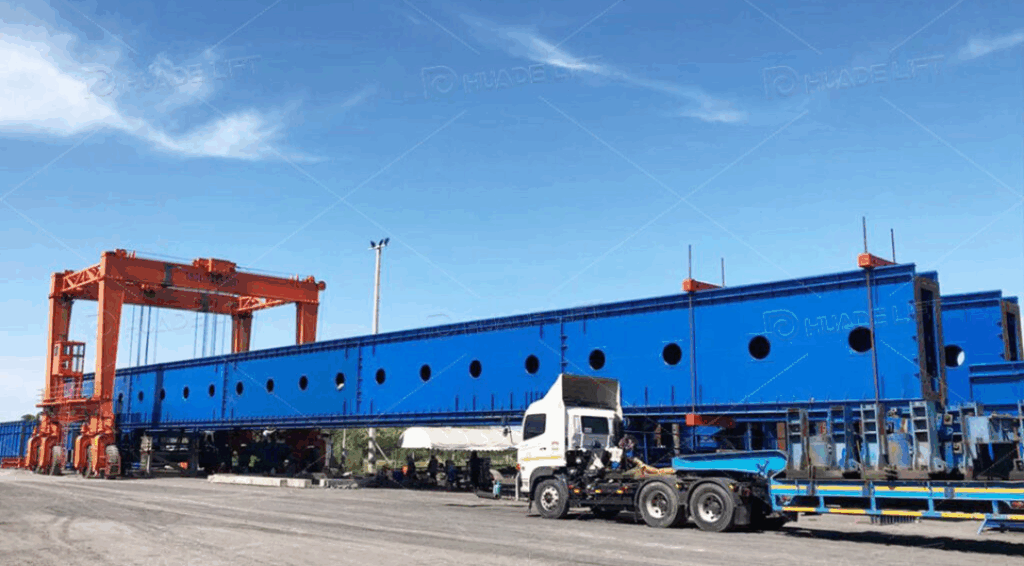
Comparison of Rubber Tyred Gantry Cranes with Other Steel Coil Handling Solutions
Comparison between Rubber Tyred Gantry Cranes and Bridge Cranes
Bridge cranes have stable operation and sufficient load-bearing capacity, suitable for steel coil handling in fixed indoor areas, but have insufficient flexibility, require the laying of tracks, have limited operation range, and need multiple machines to cooperate in large warehouses, with high equipment and infrastructure investment, complex installation and commissioning, and no flexibility for layout adjustment in the future.
Rubber tyred gantry crane breaks away from track restrictions, has no blind spots in operation range, one device can cover the entire warehouse, suitable for indoor and outdoor operations, simple installation and commissioning, low investment costs, and far superior flexibility and adaptability compared to bridge cranes, more suitable for temporary warehouses or flexible layout scenarios.
Comparison between Rubber Tyred Gantry Cranes and Rail-mounted Gantry Cranes (RMG)
The RMG and rubber tyred gantry crane have similar structures, with strong carrying capacity and high operational efficiency. They are suitable for transporting large quantities of steel coils in fixed areas. However, they require the laying of tracks, which incurs high infrastructure costs. They also lack flexibility and have high adjustment difficulty in the later stage, making them unsuitable for small and medium-sized warehouses or scenarios with flexible layouts.
The operational efficiency of rubber tyred gantry crane is slightly lower than that of RMG, but it is highly flexible and has lower investment costs. It does not require the laying of tracks and can be adapted to different warehouse layouts. It offers better cost performance and can handle both large quantities of steel coils and small batches with various specifications. It also caters to indoor and outdoor operation needs.
Key Factors for Selecting Rubber Tyred Gantry Cranes for Steel Coil Handling
Matching Carrying Capacity with Steel Coil Weight
The selection must ensure that the rubber tyred gantry crane’s carrying capacity matches the weight of the steel coil. Insufficient capacity can lead to safety accidents, while excessive capacity results in resource waste. It is necessary to consider the regular and maximum weight of the steel coil, and reserve a certain carrying margin for batch handling to accurately calculate the weight and achieve maximum cost-effectiveness.
Adapting to Span, Lifting Height and Warehouse Layout
The span should cover the width of the operation area and be compatible with the stacking of steel coils or the spacing of shelves. It should also consider the stability of the equipment. The lifting height should meet the requirements for stacking layers, improve storage density, and also take into account the height of the warehouse space and operational safety. Excessively high lifting height can increase costs and risks.
Power Mode and Energy-saving Requirements
Diesel-driven rubber tyred gantry cranes have strong mobility and are suitable for outdoor or temporary warehouses without stable power supply, but they have high energy consumption and poor environmental performance. Electric-driven rubber tyred gantry cranes have lower energy consumption and better environmental performance, suitable for indoor scenarios with stable power supply.
However, their flexibility is limited by power lines. Hybrid power combines mobility and environmental performance and is currently the mainstream choice for rubber tyred gantry crane in steel coil handling, requiring selection based on warehouse power supply, environmental requirements, and operational costs.
Halter Selection and Compatibility with Steel Coil Types
The hoist directly affects the safety and stability of handling. It needs to be selected based on the specifications and surface requirements of the steel coil. High-precision steel coils require protective hoists.
HuadeLift provides diversified hoist options for different types of steel coils, allowing for flexible combinations, while considering safety and convenience to improve operational efficiency and reduce risks. It also needs to consider the durability of the hoist to reduce replacement frequency and operational costs.
Selection of Automation and Control Methods
Manual operation has low investment and flexibility, suitable for scenarios with small operation volumes and diverse specifications. However, it requires high technical skills from operators. Semi-automatic operation reduces workload and improves efficiency, retaining manual control, suitable for medium-sized scenarios.
Fully automatic operation is unmanned, efficient, and safe, suitable for large warehouses with large quantities and uniform specifications. However, it has high investment costs and requires high infrastructure and management requirements. The choice should be based on actual needs.
Core Design Needs of Rubber Tyred Gantry Cranes for Steel Coil Handling
The rubber tyred gantry crane design should be tailored to the requirements of steel coil handling, optimizing in multiple aspects to ensure stable, safe, and efficient operation, while also considering equipment durability and economy.
Carrying Capacity and Span
The carrying capacity should be designed based on the weight range of the steel coil. High-strength materials should be used to manufacture core components to ensure structural strength while considering flexibility. The span should be compatible with the warehouse layout, covering the operation area, and balancing stability and operational range. The design should be optimized through precise mechanical calculations.
Lifting Mechanism and Hoist
The lifting mechanism needs to optimize the transmission system, use high-precision reducers and motors, and be equipped with anti-shake systems to ensure the smooth lifting and movement of the steel coil, reducing shaking. The hoist is designed for the characteristics of the steel coil and is available in adjustable styles to adapt to different specifications. It is convenient for replacement. The lifting height should meet the stacking requirements and leave safety margins.
Wheels and Steering
Wheels should be selected with high-strength, wear-resistant rubber tires. The number and layout of wheels should be configured based on the carrying weight to ensure uniform load distribution. The steering design should have multiple modes to adapt to complex warehouse layouts, allowing for flexible turning and direction adjustment, improving operational flexibility.
Power System
The power system takes into account power, energy consumption and environmental protection. For electric drive, a stable power supply system and safety protection devices need to be designed; for diesel drive, the fuel system needs to be optimized and an exhaust gas treatment device needs to be equipped; for hybrid drive, the power switching system needs to be optimized to achieve efficient operation.
Automation and Control System
Equipped with positioning, anti-shake and monitoring systems to enhance the accuracy and safety of operations; the control system is simple to operate, has fault diagnosis functions, is convenient for operation and maintenance, and can be connected with the warehouse management system to achieve intelligent management.
Structure and Protection
For outdoor operations, corrosion-resistant materials and protective coatings need to be used, the electrical system needs to be well sealed and protected, lightning protection and static electricity protection devices need to be equipped, and a wind-resistant structure needs to be designed; when storing steel coils outdoors, additional protective devices can be added to protect the quality of the steel coils and extend the service life of the equipment.
Common Risks in Steel Coil Handling Projects and How to Avoid Them
Steel coil handling is a high-risk operation, common risks need to be identified and avoidance measures taken to ensure safe and smooth operations and reduce enterprise operational risks.
Mismatch between Crane Carrying Capacity and Actual Load
This is the most common risk. Insufficient carrying capacity can lead to equipment damage and steel coil drops. Avoidance method: Precisely calculate the weight of the steel coil during selection, strictly follow the carrying limit during operation, regularly test the equipment carrying capacity, and promptly handle aging and worn components.
Insufficient Safety Design of Rubber Tyred Gantry Cranes
Inadequate safety protection devices and insufficient lifting equipment performance can easily cause steel coil slippage and collision. Avoidance method: Ensure the selection and design include complete protective devices, select qualified lifting equipment, conduct regular inspections and maintenance, and replace damaged components in a timely manner.
Unreasonable Warehouse Layout Planning
Narrow channels, many obstacles, and dense stacking of steel coils will limit the movement of rubber tyred gantry crane and increase the risk of collision. Avoidance method: Reserve sufficient operation space during warehouse planning, design channels and stacking layouts reasonably, and clear obstacles in time during operations.
Underestimating the Impact of Equipment Maintenance and Downtime
Long-term high-intensity operations can lead to component wear, and ignoring maintenance can cause faults and affect progress. Avoidance method: Establish a complete maintenance system, conduct regular inspections and maintenance, replace worn components in a timely manner, reserve downtime for maintenance, and strengthen operation personnel’s training on equipment maintenance.
Selecting Suppliers without Industry Experience
Equipment from inexperienced suppliers is prone to quality defects and subsequent services cannot be guaranteed. Avoidance method: Choose experienced and reputable suppliers, prioritize those with cases of steel coil handling equipment, sign a complete cooperation agreement, and clearly define equipment quality and service standards.
Conclusion
Rubber tyred gantry cranes have gained popularity due to their flexibility in movement, stable load-bearing capacity, and universal adaptability, making them an ideal equipment for handling steel coils. They can address the shortcomings of traditional equipment.
In practical applications, proper selection of models, maintenance, and risk prevention are necessary. In the future, they will be upgraded towards automation and energy conservation, helping enterprises reduce costs, increase efficiency, and enhance competitiveness.
