
Introduction
In the construction of large-scale bridges such as high-speed railways, expressways and municipal elevated roads, the transportation and erection of precast box girders, T-shaped girders and U-shaped girders are key processes. These precast girders are massive, weighing between 50 and 500 tons. Furthermore, construction sites often feature temporary, makeshift roads and limited working space, while the self-weight distribution of the beams is uneven and they have both ends that are suspended. Conventional transport equipment struggles to adapt to these complex conditions, making it highly likely to trigger various construction hazards.
As specialized heavy-duty equipment for bridge construction, the appropriate selection of a girder transporter directly determines construction safety, project progress, and construction costs. Improper selection can easily result in girder damage or even safety incidents such as overturning. Therefore, the scientific selection of a girder transporter suited to the specific working conditions is of paramount importance in bridge construction.
What are Bridge Girders and Why do They Need Specialized Transport Equipment?
Core Function of Bridge Girders
Bridge girders are the core load-bearing components of the entire bridge structure, with common types including box girders, T-beams, and U-beams. They primarily bear the loads from the bridge deck pavement and vehicle traffic, while also distributing external forces generated by natural environmental factors such as wind, rain, and temperature fluctuations.
During long-term operation, bridges must continuously withstand wear, vibration, and external impacts. The structural stability and load-bearing capacity of the girders directly determine the bridge’s service life and traffic safety, making them an irreplaceable core component of bridge engineering.
Challenges in Transporting Large Girders
Large precast beams have extremely long shapes, concentrated loads and special structures. Ordinary trailers are unable to handle the transportation task and posing extremely high construction risks. Conventional transport equipment has limited load-bearing capacity in its chassis and axles, so prolonged heavy loads can easily lead to structural deformation and even damage to the vehicle or the beam.
Additionally, the uneven distribution of the precast beam dead and the large cantilever lengths at both ends make it highly prone to shifts in the center of gravity during vehicle acceleration, deceleration, and turns, potentially causing safety incidents such as beam slippage or vehicle rollovers. Furthermore, bridge construction sites often consist of temporary dirt roads with limited working space, so common equipment is unable to achieve smooth passage and precise alignment because of poor mobility. Additionally, load distribution on standard vehicles is uneven, leading to localized overloading—a condition that not only violates transportation regulations but also damages construction roads and bridge foundations.
Critical Role of Girder Transporters
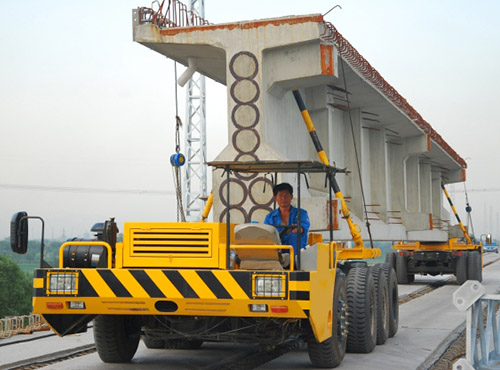
HuadeLift’s dedicated girder transporters are heavy-duty vehicles specifically designed for the unique dimensions, weight and structural form of bridge girders. It is fundamentally different from ordinary flatbed trailers and general heavy-duty truck trailers. The overall structure of the equipment has been specially optimized to evenly distribute the concentrated load of the girder across multiple sets of axles and wheels, thereby eliminating the problem of excessive pressure at any single point at its source. At the same time, the accompanying support and securing structure firmly holds the beams in place, preventing displacement or misalignment during transport.
Whether it is the bumpy temporary roads, the narrow construction spaces, or the transportation scenarios involving large-tonnage and super-long beam structures, the customized girder transporter can be stably adapted to. They can perform a series of operations including smooth lifting and lowering, precise steering and safe positioning, thereby addressing the safety shortcomings and efficiency deficiencies of ordinary transport equipment.
Working Principle and Applications of Girder Transporters
Definition and Working Principle of Girder Transporters
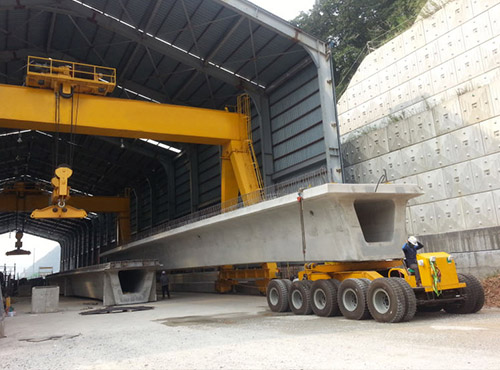
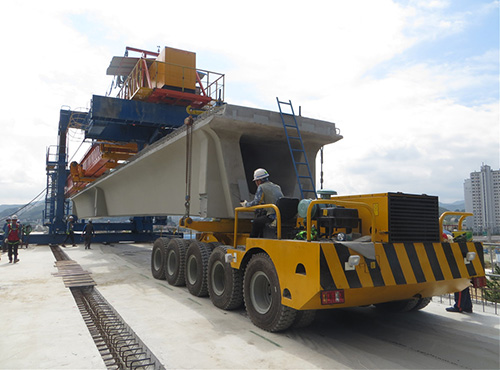
Girder transporters are core supporting equipment for bridge construction, specifically designed for the transport and precise positioning of precast beams. Equipped with multi-axle hydraulic suspension, independent hydraulic steering, dual-power drive, and an electronically controlled monitoring system, they can meet the construction requirements for various types of heavy-duty girders.
During operation, the vehicle’s specialized support structure securely fastens the beam in place. The hydraulic system smoothly lifts the component, while the multi-axle structure evenly distributes the total load, effectively preventing excessive localized stress.
Relying on precise hydraulic adjustment and steering systems, the girder transporter can independently perform operations such as straight driving, turning, and fine adjustment for positioning. It can complete the entire process of installing, transporting, and lowering the girder in one step.
Core Structural Components
The core structure of a high-performance girder transporter consists of multiple systems working in concert to ensure stable and efficient heavy-load operations. The equipment features a high-strength steel frame as its load-bearing main structure, which offers high rigidity, is resistant to deformation, and can withstand hundred-metric-ton loads over the long term.
The hydraulic lifting and balancing system serve as the core operational component, responsible for lifting and lowering the beam as well as fine-tuning its orientation. It can level the beam in real time on uneven surfaces to maintain stability. The multi-axle linked steering system enhances the equipment’s maneuverability, enabling tight-radius turns and precise adjustments to meet the passage requirements of narrow construction sites. Combined with a stable drive system, it ensures smooth and seamless operation throughout the entire driving and braking process. At the same time, the intelligent electronic control monitoring system collects real-time data on equipment load and operational status, enabling operators to monitor work conditions, mitigate safety risks, and ensure safe and precise operations.
Main Application Scenarios
The girder transporter is suitable for a vast majority of large-scale bridge infrastructure projects and offers exceptional versatility. In highway bridge, railway, and high-speed rail elevated projects, it serves as the core equipment for transporting precast beams.
In urban municipal interchange and elevated road construction scenarios, they can adapt to operations in narrow urban spaces to achieve precise beam positioning. They are also applicable to large-scale bridge projects across rivers and seas.
In addition to on-site construction, beam transporters are frequently used for on-site transportation within precast girder yards, facilitating the seamless transition between beam demolding, stacking, and loading, thereby meeting the construction needs of the entire bridge engineering process.
Types of Girder Transporters
Different types of girder transporters vary significantly in structural design, load-bearing capacity, and suitable applications. Construction companies must select the appropriate model based on project road conditions, beam weight, and available construction space to avoid delays caused by improper equipment selection.
Hydraulic Girder Transporters
Hydraulic girder transporters are equipped with a complete set of adjustable hydraulic mechanisms. The lifting height and support spacing can be flexibly adjusted, enabling it to accommodate various forms and specifications of girder types such as box girders, T-girders, and U-girders.
They offer distinct advantages in beam alignment and fine-tuning operations, enabling precise matching of the bridge erector’s working height and position to meet the demands of precision construction. They are well-suited for high-speed rail and municipal bridge projects that require high installation accuracy.
Self-Propelled Girder Transporters
Self-propelled girder transporters are equipped with their own diesel or electric power systems, eliminating the need for additional towing equipment. They can independently perform all operations, including travel, steering, and lifting. The equipment offers excellent overall maneuverability with fast startup and control response time.
This type of machine is highly adaptable to various site conditions and can operate on uneven ground and slightly sloped outdoor construction sites. It is currently the most widely used model in small-, medium-, and large-scale bridge projects, offering outstanding versatility and practicality.
Multi-Axle Girder Transporters
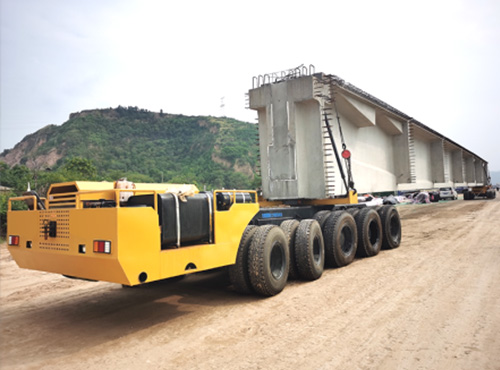
Multi-axle girder transporters feature a dense layout of multiple axles and wheels, achieving an extremely good load distribution effect. They effectively disperse the concentrated pressure of super-heavy beams, preventing road surface damage and equipment deformation.
This model is designed for high-tonnage load-bearing capacity, capable of stably transporting 300 to 500 ton precast box girders. It is suitable for construction projects involving super-heavy girders, such as large-scale expressways and cross-sea bridges, making it the equipment of choice for high-tonnage bridge engineering.
Modular Girder Transporters
Modular girder transporters feature a modular structural design that allows for flexible addition or removal of modules based on girder length and weight, enabling free adjustment of the equipment’s overall dimensions and load-bearing specifications.
For special beams with extra-long or oversized dimensions, this model offers far greater adaptability than conventional equipment. Additionally, the equipment can be disassembled for storage and reused multiple times, making it well-suited for large-scale projects involving multiple batches of beams in various specifications and offering better cost-effectiveness.
Crawler Girder Transporters
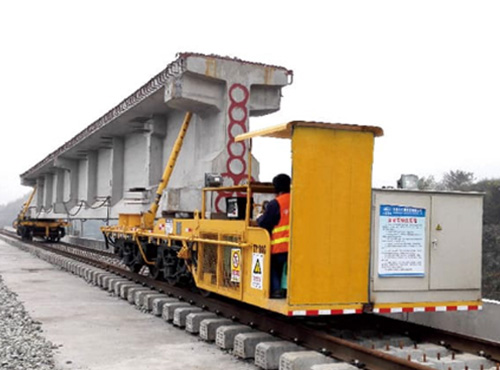
The crawler-type girder transports abandon the traditional wheeled structure in favor of a crawler-based propulsion system, providing a large contact area with the ground and excellent traction. The equipment offers high overall stability and is resistant to slipping or sinking.
It is specifically designed for harsh conditions such as soft soil roads, muddy terrain, and steep slopes, and is commonly used in projects with complex road conditions, such as remote rural bridges and mountainous infrastructure projects. Even on construction sites with poor load-bearing capacity, it can reliably transport heavy girders.
Advantages of Using Girder Transporters
Improve Construction Efficiency
Professional girder transporters can independently complete the entire process—from loading to transport to unloading—without requiring coordination among multiple pieces of equipment, which significantly simplifying construction procedures and reducing handover wait time.
When handling large-span and super-heavy girders, the dual-vehicle synchronized operation mode enables the transport of large components in a single trip, eliminating the cumbersome steps of repeated disassembly and transfer. The stable operational rhythm effectively shortens the construction cycle and ensures project progress.
Guarantee Construction Safety
HuadeLift’s specialized girder transporters are equipped with hydraulic anti-tilt structures, multi-stage braking systems, and real-time load monitoring devices. These systems dynamically adjust girder balance throughout the entire process—from starting and driving to turning and braking—and instantly detect potential hazards such as abnormal loads and posture deviations.
This protective mechanism mitigates risks such as beam slippage, vehicle rollovers, and structural damage at the source, ensuring the safety of personnel and equipment during construction while effectively preventing economic losses caused by beam damage.
Intelligent Control System
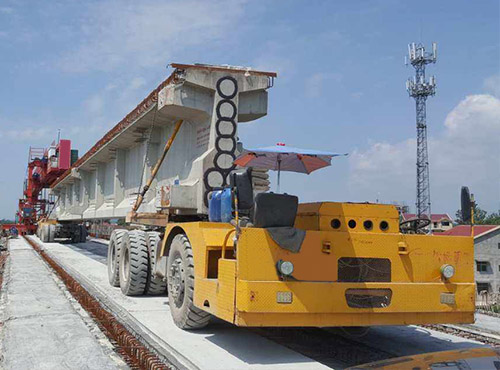
The girder transporter is equipped with a mature electronic control system that supports wireless remote operation and automatic calibration functions, allowing operators to precisely control the equipment’s operation, alignment, and fine-tuning from a distance. The system can be integrated with launching gantry for coordinated operations, creating an integrated transport and erection construction model. This reduces manual alignment errors, meets the high-precision construction standards required for high-speed rail and large-scale bridge projects, and aligns with the standards for precision infrastructure construction.
Adapt to Complex Conditions
This specialized girder transport support customized adjustments to the number of axles, load capacity, vehicle length, and steering modes, allowing it to flexibly adapt to different types of bridge projects, including highway, high-speed rail, municipal, and river- or sea-crossing bridges. It is also compatible with a wide range of mainstream girder specifications, ensuring stable operation with conventional box girders, T-beams, and even irregular U-shaped girders. The equipment exhibits high tolerance to complex outdoor environments, including extreme temperatures and inclement weather such as wind and rain, ensuring long-term stable operation and strong reusability.
Key Factors of Girder Transporters Selection
Load Capacity and Compatibility
Load capacity is the core fundamental metric for selecting a girder transporter. When making selection of girder transporter, one must not rely solely on the girder’s self-weight. The total weight of the girder and associated components must be considered to ensure sufficient payload margin, thereby avoiding long-term operation at full capacity or under overload conditions.
Conventional bridge girders typically weigh between 100 and 500 tons, for which suitable models can be selected. For heavy-duty beams weighing over 100 tons, specialized heavy-load girder transporters must be selected, with strict control over axle load distribution to prevent equipment deformation, road surface damage, and beam damage.
Construction Site Conditions
Construction site conditions and the operational space are key factors in model selection. For harsh terrain such as rugged dirt roads and steep slopes in remote areas, tracked or high-horsepower self-propelled girder transporters are recommended for greater stability. For level, paved surfaces at precast beam yards, rail-mounted or modular models are more suitable, as they offer higher operational efficiency and reduced equipment wear. In narrow urban construction environments, beam transporters with small turning radii and high maneuverability should be prioritized to accommodate limited working spaces.
Equipment Dimensions and Beam Specifications
Equipment selection must be based on the beam’s length, width, and overhang dimensions to match the appropriate specifications. Standard models are suitable for conventional beams, while modular girder transporters that can be flexibly assembled are better suited for extra-long or extra-wide special beams.
Additionally, it is necessary to survey the width of on-site access routes, turning radii, and entry spaces in advance to avoid obstructions caused by mismatched equipment dimensions, as well as misalignment of supports, which could impact loading, unloading, and alignment during construction.
Tire and Chassis Structural Performance
The tires and chassis structure directly determine the stability and service life of the girder transporter and can be flexibly configured based on construction road conditions and load scenarios. Smooth, paved surfaces are best suited for wear-resistant, stable solid rubber tires, while rough, temporary dirt roads outdoors should prioritize pneumatic tires to cushion road vibrations and protect both the equipment and the girders. For super-heavy-duty transport operations, high-pressure, ultra-elastic heavy-duty tires are required.
For the equipment chassis, a high-strength monocoque steel structure paired with a shock-absorbing suspension is recommended. This effectively distributes concentrated loads and resists deformation even during long-term, high-frequency heavy-load operations, fully meeting the demanding construction requirements of large-scale bridge projects.
Braking System Safety Performance
The braking system is the core safety assurance for heavy-load girder transportation. For the transport of small- and medium-sized girders, a basic parking brake is sufficient to meet operational requirements. However, for the transport of heavy girders weighing hundreds of tons, a dual-braking system combining air brakes and a parking brake is required. This braking mode offers rapid response and balanced braking force, making it suitable for demanding conditions such as heavy-load driving, parking on slopes, and precise alignment. It effectively prevents safety hazards such as vehicle rollaway and component displacement, ensuring comprehensive safety during transport operations.
Choose Right Girder Transporter Supplier
Professional Customized Capabilities
A high-quality equipment supplier must possess mature engineering research and development capabilities to provide customized solutions tailored to the girder weight, dimensions, and construction site conditions of different projects.
HuadeLift has a professional engineering and technical team that can adjust the number of axles, load capacity, structural layout, and control systems according to actual project requirements to accommodate various specialized bridge construction conditions.
Precision Manufacturing and Quality Assurance
The stability and durability of equipment depend on standardized manufacturing processes and a comprehensive quality control system. Reputable manufacturers strictly adhere to industry standards, implementing full-process quality inspections—from raw material selection, component machining, and complete unit assembly to factory commissioning—to effectively ensure structural strength and operational stability, reduce the likelihood of on-site failures, and meet the demanding requirements of continuous construction on large-scale projects.
Efficient Delivery and Installation Services
With tight schedules for large-scale infrastructure projects, rapid equipment delivery and prompt commissioning are particularly critical. High-quality suppliers possess mature logistics and delivery systems to ensure equipment arrives on-site on time. They also provide professional technical teams to handle on-site installation, equipment commissioning, and operator training, helping construction teams begin operations quickly, effectively shortening the commissioning cycle, and ensuring project progress.
Comprehensive After-Sales Service
Comprehensive after-sales support is key to the long-term, stable operation of engineering equipment. High-quality suppliers provide full-lifecycle services, including routine inspections, scheduled maintenance, rapid emergency repairs, and the supply of genuine manufacturer parts. Leveraging timely technical and operational support, they quickly resolve equipment failures, minimize downtime and lost productivity, reduce project operation and maintenance costs, and ensure the steady progress of construction.
Conclusion
There is no single, universally optimal standard for selecting girder transporters for large-scale bridge projects. The selection must be based on actual conditions such as girder weight, dimensions, construction road conditions, operational space and comprehensively evaluate the equipment’s load-bearing capacity, structural stability, maneuverability, and safety performance to ensure a precise match. At the same time, construction companies should prioritize reputable equipment brands that offer customized R&D, strict quality control, and comprehensive after-sales support.
HuadeLift specializes in transportation equipment for bridge engineering and can precisely meet the beam transport requirements of various bridge projects, including high-speed rail, expressways, and municipal elevated structures. With specialized equipment tailored to specific operating conditions and comprehensive full-cycle support services, HuadeLift provides reliable assurance for construction safety, project progress, and cost control.
