
Introduction
Amid the accelerated growth of the global construction industry, modular construction has emerged as a key trend for enhancing efficiency, shortening project timelines, and reducing costs. Among these approaches, Volume Modular Units (VMUs) significantly transform traditional construction methods through factory prefabrication and rapid on-site assembly.
However, during modular construction, the large size and concentrated weight of VMUs present critical challenges for efficient and safe lifting operations. Conventional tower cranes and crawler cranes often fall short in flexibility and precision. Rubber-tyred gantry cranes, however, have emerged as the preferred lifting solution for VMU projects due to their mobility, high load capacity, and customizable design. This article explores the selection of RTGCs for VMU projects, helping construction companies boost efficiency and mitigate risks.
What is a Rubber Tyred Gantry Crane?
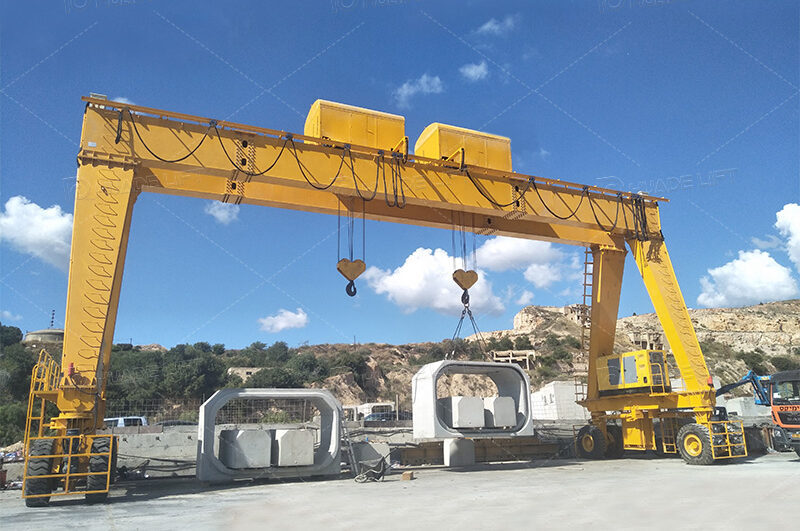
A Rubber Tyred Gantry Crane is a mobile gantry crane mounted on a rubber-tired chassis. Unlike rail-mounted gantry cranes, it requires no fixed tracks and can move freely across construction sites. This flexibility has led to its widespread adoption not only in ports, terminals, and container yards but also increasingly in the construction industry—particularly for lifting large prefabricated components and modular units.
Structural Features of Rubber-Tyred Gantry Cranes
A rubber-tyred gantry crane typically consists of a steel gantry frame, hoisting mechanism, travel system, and electrical control system. Its gantry span can be customized to project requirements, while the hoisting mechanism offers high lifting capacity, capable of handling loads ranging from tens to hundreds of tons. Additionally, the rubber-tyred travel chassis provides exceptional mobility, enabling rapid deployment across diverse construction sites.
Why Rubber-Tyred Gantry Cranes Are Particularly Suited for VMU
Transporting and lifting volumetric modular units requires equipment capable of flexible operation within confined spaces while ensuring lifting stability and safety. The structure and performance of rubber-tyred gantry cranes precisely meet these demands:
They can transition between factory and construction sites, directly participating in module unloading, handling, and lifting.
A multi-point lifting system enables smooth module hoisting, preventing structural damage from uneven stress distribution.
High customizability allows precise adaptation to VMU dimensions and weight requirements.

Characteristics and Lifting Challenges of Volume Modular Units (VMU)
Structural Features of VMU
Volume Modular Units are complete spatial modules typically prefabricated in factories. They include walls, floors, roofs, doors, windows, and even partial electrical and piping systems. The prefabricated module units are transported to the construction site as a single entity and assembled using lifting equipment.
This approach offers significant advantages, including substantially shortened construction timelines and reduced environmental impact at the site. However, the large dimensions of VMs (typically ranging from several to over ten meters in length, width, and height) and their concentrated weight—often tens to hundreds of tons—significantly increase the complexity of the lifting process.
Complexity of the Lifting Process
On-site Transfer: Upon arrival, modules often require temporary storage or immediate hoisting into position, demanding highly flexible lifting equipment.
Precision Positioning: VMU assembly requires extreme accuracy; even minor hoisting deviations can compromise overall installation quality.
Site Space Constraints: Traditional tower cranes require extensive installation space, while crawler cranes may face limitations due to ground load-bearing conditions, making access to confined or irregular sites challenging.
Safety Risks: Due to the heavy lifting weights and pre-installed components within the modules, improper operation can easily cause structural damage or safety incidents.
Special Requirements for Lifting Equipment
To meet VMU lifting demands, equipment must possess the following characteristics:
Flexible Mobility: Capable of maneuvering freely in confined or complex terrain.
High Load Capacity: Able to safely lift modules weighing tens to hundreds of tons.
Precision operation: Utilize intelligent control systems to achieve smooth lifting/lowering and precise positioning of modules.
Safety and stability: Incorporate protective features against wind, sway, and overturning.
The rubber-tyred gantry crane (RTGC) stands out as the optimal solution for these requirements. It not only meets the efficiency demands of modular construction but also ensures safety and controllability during lifting operations, making it the ideal choice for VMU projects.
Key Considerations for Selecting a Rubber-Tyred Gantry Crane
When choosing a rubber-tyred gantry crane for Volume Modular Unit (VMU) projects, enterprises must evaluate multiple dimensions. A suitable crane not only ensures lifting safety but directly impacts project timelines and overall costs. The following factors are paramount:
Lifting Capacity
Given that VMUs typically weigh tens to over a hundred tons, lifting capacity is the foremost consideration. An insufficient rated load capacity renders the crane incapable of completing the task, while excessively high capacity leads to unnecessary equipment investment and operational costs. Therefore, companies must select a rubber-tyred gantry crane with appropriate tonnage based on the unit module weight to ensure both safety and cost-effectiveness.
Span and Lifting Height
Projects vary significantly in spatial requirements for lifting. For instance, residential modules typically stand around 3 meters tall, while commercial buildings may utilize taller VMUs. This necessitates a rubber-tyred gantry crane with sufficient lifting height to cover all lifting demands. Simultaneously, the span size determines whether the equipment can traverse module units during lifting. In densely stacked module yards, an appropriate span significantly enhances lifting efficiency.
Mobility and Flexibility
A major advantage of rubber-tyred gantry cranes is their ability to move freely on construction sites without requiring tracks. However, mobility varies across different models. Some rubber-tyred gantry cranes feature all-wheel steering systems, enabling nimble operation in confined spaces—ideal for VMU projects with limited room. For construction firms requiring frequent relocation, flexibility becomes a decisive factor.
Intelligent Control and Precision
Positioning accuracy is paramount in VMU lifting operations. Intelligent rubber-tyred gantry cranes feature anti-sway control systems and automatic positioning functions, preventing module sway during lifting and ensuring precise placement. Additionally, some models support remote operation and automated tasks, further enhancing construction safety and efficiency. These capabilities are particularly suited for highly precision-demanding modular buildings like hospitals or schools.
Energy and Environmental Sustainability
As green building principles gain traction, the environmental performance of construction equipment has become a critical consideration. While traditional diesel-powered RTG cranes offer robust power, their high emissions hinder sustainable development. Modern electric RTG cranes or hybrid-powered equipment significantly reduce carbon emissions while lowering operational costs. For construction firms prioritizing ESG (Environmental, Social, and Governance) metrics, this represents an essential evaluation factor.
RTG Crane Application Cases in Volumetric Modular Units Projects
Rubber-tyred gantry cranes have demonstrated significant advantages in numerous global modular construction projects. Below are several typical application scenarios.
Residential Modular Construction
In housing projects, volumetric modular units are typically prefabricated off-site, requiring only on-site hoisting and assembly. Rubber-tyred gantry cranes can directly receive delivered modules at the construction site and swiftly position them into place. This approach dramatically shortens residential construction cycles, significantly reducing the time from foundation work to project handover.
Hotel and Dormitory Projects
Hotels and dormitories often require large numbers of repetitive units, making VMUs highly prevalent in such projects. Rubber-tyred gantry cranes enable efficient lifting and rapid positioning, allowing installation of multiple modular floors within a single day. This not only accelerates project timelines but also ensures stable and secure lifting operations.
Hospital and School Construction
Public facilities like hospitals and schools demand exceptionally high precision and safety in construction. Using rubber-tyred gantry cranes for VMU lifting minimizes on-site disruption while ensuring smooth, precise operations through intelligent control systems, thereby reducing risks. Particularly in healthcare projects, shorter construction timelines enable faster delivery of critical services to the community.
Matching Appropriate Customization Options
Given the vast differences in lifting requirements across projects, customized rubber-tyred gantry crane solutions are crucial in modular construction. When selecting equipment, enterprises should tailor solutions to their specific needs to achieve optimal construction outcomes.
Customizing Span and Lifting Height
Based on the VMU’s dimensions, appropriately customize the span and lifting height of the rubber-tyred gantry crane to ensure full coverage of the lifting space. For instance, large commercial complexes require significantly greater spans than typical residential projects, while medical facilities demand additional lifting height specifications.
Multi-Lifting Points and Synchronized Lifting Systems
When lifting oversized modules, a single lifting point may cause uneven stress distribution, potentially leading to module deformation or damage. Rubber-tyred gantry cranes equipped with multi-lifting points and synchronized lifting systems achieve more stable force distribution, effectively safeguarding the structural integrity of modules.
Remote Monitoring and Automation Features
Modern rubber-tyred gantry cranes can be fitted with optional remote monitoring systems, enabling managers to track equipment operation status and construction progress in real time. Simultaneously, automation capabilities minimize human error, significantly enhancing lifting precision and efficiency.
Scalable Design
As companies anticipate undertaking larger or more complex modular projects in the future, selecting a rubber-tyred gantry crane with scalability is crucial. By incorporating expansion interfaces or upgrade provisions, the equipment can remain viable for subsequent projects, avoiding redundant investments.
Future Development Trends of RTG Cranes in Modular Construction
As the modular construction industry rapidly evolves, demands for lifting equipment are also advancing. Future RTGs will exhibit several key trends:
Intelligence and Automation
Future modular construction RTGs will increasingly integrate AI technology and intelligent control systems. For instance, automated path planning and anti-sway systems enable precise positioning of modular units. AI learns from historical data to optimize lifting parameters, enhancing overall efficiency. These intelligent features will reduce reliance on manual expertise, making lifting operations safer and more efficient.
Green Energy Adoption
The construction industry is accelerating its green transition, making carbon emissions from construction equipment a critical concern. Electric rubber-tyred gantry cranes and hybrid solutions will gradually replace traditional diesel-powered equipment, lowering operational costs while meeting environmental policy requirements. For sustainability-focused enterprises, selecting green rubber-tyred gantry cranes will become a key strategy for enhancing brand value.
Digital Twin and BIM Integration
The integration of rubber-tyred gantry cranes with BIM (Building Information Modeling) and digital twin technology represents a key future development direction. Through virtual modeling and real-time monitoring, construction teams can simulate the entire lifting process beforehand, optimize lifting paths, and avoid potential risks. Simultaneously, digital twins provide real-time feedback on equipment status, enabling predictive maintenance and extending equipment lifespan.
Modular Construction Scaling Drives Demand Growth
As the global modular construction market continues to expand—particularly with the rapid increase in large-scale residential, hotel, and public facility projects across North America, Europe, and Southeast Asia—demand for rubber-tyred gantry cranes for volumetric modular units will steadily rise. Customized and scalable rubber-tyred gantry cranes will become the market mainstream in the future.
Global Application Trends
Currently, North America leads in residential and hotel modular construction, driving sustained demand for rubber-tyred gantry cranes. Europe prioritizes green and smart development, favoring electric or hybrid rubber-tyred gantry cranes. Emerging markets like Southeast Asia, fueled by infrastructure construction booms, are poised to become among the fastest-growing regions. These trends indicate increasingly diverse application scenarios for rubber-tyred gantry cranes, with highly promising market prospects.
Conclusion
In Volume Modular Unit (VMU) projects, lifting operations are pivotal to construction efficiency and quality. Rubber-tyred gantry cranes (RTGCs) have become core equipment for such projects due to their high load capacity, exceptional mobility, precise operation, and high customization advantages.
Selecting the right rubber-tyred gantry crane reduces reliance on traditional lifting equipment, significantly boosting lifting efficiency, shortening project timelines, and lowering labor and safety risks. Through prudent investment in maintenance, enterprises can also achieve sustained benefits across multiple projects, realizing long-term returns.
In the future, as modular construction expands globally, rubber-tyred gantry cranes will continue to evolve toward greater intelligence, sustainability, and digitalization. For construction companies, making prudent investments and selecting appropriate customized rubber-tyred gantry crane solutions are crucial measures to safeguard competitiveness and enhance project success rates.
