
Introduction
Marine travel lifts are essential shore-based equipment for yacht clubs, private marinas, and small- to medium-sized shipyards. Routine operations such as bringing vessels ashore for maintenance, end-of-season storage, and launching new boats all rely on this equipment. Compared to traditional cranes, Huadelift marine travel lifts offer full mobility, greater adaptability to marina sites, and the ability to handle lifting operations for vessels of various sizes, making them the mainstream choice for marina operations and maintenance today.
When selecting a marine travel lift, there is no need to blindly pursue high lifting capacity or low prices. The most suitable choice is a model that aligns with your terminal’s operating conditions, vessel specifications, and operational frequency.
Marine Travel Lifts Design Features
The operational safety and stability of marine travel lifts rely on their structural design. High-quality marine travel lifts on the market adhere to established industry standards for core configurations, which serve as the most fundamental criteria for evaluation during the selection process. Understanding these structural designs allows you to quickly assess the equipment’s build quality and durability.

High-Strength Structural Frame
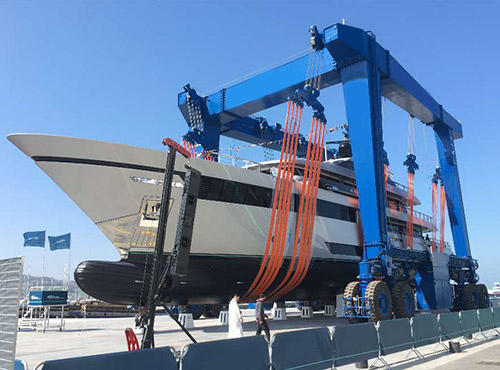
The frame determines a marine travel lift’s load-bearing capacity, resistance to deformation, and service life. Huadelift’s marine travel lifts use high-strength welded box beams and an integrated rectangular steel structure. Compared to ordinary assembled frames, this design distributes stress more evenly, effectively preventing localized stress concentration.
Most marine lifting loads are asymmetrical, which can easily cause the framework to bear eccentric pressure. Through structural optimization, marine travel lifts avoid areas of structural weakness and utilizes reinforced crossbeams to distribute the load, effectively reducing the likelihood of body twisting and deformation.
Multi-Wheel Load Distribution System
Most older docks have relatively low ground bearing capacity. The single-point load-bearing method used by conventional lifting equipment can easily damage the pavement and cause ground subsidence. Marine travel lifts employ a multi-wheel load distribution design that completely resolve this issue. By replacing the traditional few-point load-bearing model with multi-point load distribution, they perfectly adapt to the site conditions required for heavy-load operations at docks.
Multiple sets of wheel assemblies work in coordination to evenly distribute the vessel’s weight across the ground, effectively reducing the pressure of per unit area. This not only protects the wharf’s pavement structure but also enhances the equipment’s traction on uneven surfaces, preventing issues such as one side becoming suspended or slipping during operations.
Hydraulic Synchronized Lifting System
The greatest safety hazard in hull lifting is tilting or shifting during lifting and lowering. Uneven lifting speeds at the lifting points can cause the hull to twist, resulting in permanent damage to the yacht’s paintwork, hull structure, and interior. The hydraulic synchronization system is the core solution to this problem.
This synchronization control mechanism is suitable for all types of precision hulls and vessels with uneven ballast, maintaining the hull’s level throughout the process to prevent structural damage caused by height differences, and fully meeting the operational requirements for precision lifting of high-end vessels.
Multi-Mode Steering Control System
Most of the berths at the docks are densely packed and the channels are narrow, making it difficult for conventional lifting equipment to move flexibly. Marine travel lifts feature four modes—straight travel, diagonal travel, crab-walk lateral movement, and independent wheel steering—to adapt to the layout of different port facilities.
Equipped with a PLC control system, marine travel lifts can switch steering modes as needed. It is also equipped with anti-skid wheel control and load-limiting speed function, which can prevent problems such as rapid steering and skidding under heavy load conditions, ensuring a smooth and controllable movement throughout the entire process.
For confined work environments, crab-walk mode enables precise lateral positioning without the need for significant adjustments to the machine’s body. Independent wheel steering significantly reduces the turning radius, allowing the equipment to navigate narrow passages with ease and perfectly solving the challenges of load-bearing operations in tight spaces.
Anti-Sway Load Stabilization Technology
Outdoor docks are often subject to light winds and uneven ground, making it highly likely for the hull to sway during lifting operations. Even slight oscillations under heavy loads can amplify impacts, which not only affect operational precision but also pose certain safety risks.
The marine travel lift is equipped with a hydraulic damping system and a controllable acceleration and deceleration program, which effectively mitigates inertial sway caused by equipment start-up and shutdown. Combined with mechanical guidance and load positioning structures, it limits the amplitude of the vessel’s sway throughout the entire process.
This stabilization system cushions dynamic impact forces under complex operating conditions, ensuring a smooth process for vessel hoisting, lowering, and transfer even in windy conditions or on slightly uneven ground, making it well-suited for variable outdoor operating environments.
Efficiency of Marine Travel Lifts
For docks and shipyards, equipment mobility directly determines the overall pace of operations. The core advantage of marine travel lifts over fixed lifting equipment lies in their flexible, all-terrain mobility, which simplifies workflows, reduces reliance on other equipment, and meets the demands of high-frequency vessel turnaround.
Self-Propelled Independent Operation
Traditional ship launching and hauling-out operations rely on the coordinated use of multiple pieces of equipment—such as cranes, tow trucks, and forklifts—which requires significant manpower, involves cumbersome processes, and results in low operational efficiency. Rail-mounted cranes, in particular, are constrained by fixed tracks, have a limited operating range, and offer extremely poor site flexibility.
Marine travel lifts feature an integrated self-propelled design that requires no track laying or external towing. They can move freely throughout the entire terminal area and independently complete the full range of operations—including vessel launching, beaching, transshipment, and storage—streamlining operational workflows and effectively shortening the turnaround time per vessel.
Multi-Wheel Design for Stable Transportation
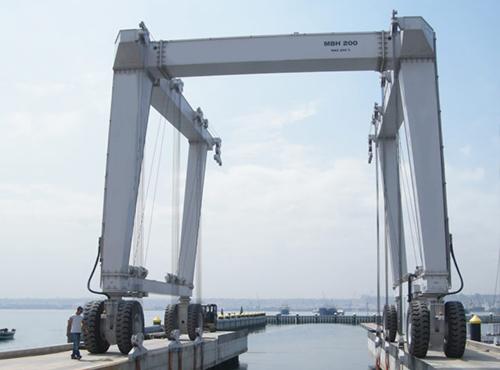
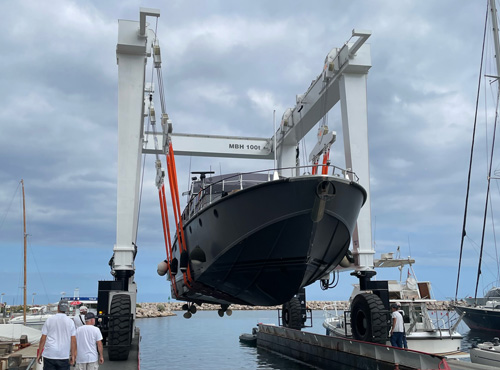
Vessels of different tonnages have varying requirements for equipment load-bearing capacity and travel stability. A marine travel lift is equipped with a tiered wheel set configuration that adapts to all vessel lifting and transport scenarios, covering operations ranging from small recreational yachts to large commercial vessels.
Multi-wheel load-distribution structure ensures smooth, bump-free, and stable movement under heavy loads without tilting, while effectively reducing ground pressure. Standard dock paving requires no additional reinforcement, protecting the surface and saving on site renovation costs.
Flexible Steering Modes
Multi-mode steering adapts to various operational scenarios: straight-line mode is ideal for long-distance transport within the dock, efficiently completing cross-area vessel transfers. Crab mode supports lateral movement, allowing precise alignment with maintenance stations and storage racks.
Flexible switching between multiple steering modes enables the equipment to adapt to various compact and irregular terminal layouts. Even in the limited space of small yacht clubs, it can operate flexibly, making full use of every available area.
Streamlining Operation Procedures
The efficiency of many port operations is relatively low. This is mainly due to the scattered types of equipment and the complicated process interconnections. Different operation stages require the switching of equipment, which takes a considerable amount of time. Marine travel lift supports multi-purpose use, effectively simplifying marina workflows and optimizing the overall operation and maintenance rhythm.
A single equipment can independently complete the entire process, without the need for multiple devices to cooperate and rotate, significantly reducing the waiting time for each process.
With streamlined processes, vessel turnaround efficiency increases and marina space utilization is maximized. This enables marinas to handle more maintenance and berthing operations while reducing customer wait times and enhancing overall operational capacity.
Marine Travel Lifts for Harsh Environment
The high salt fog, high humidity, and intense UV radiation found at coastal docks are the primary causes of wear and tear on all types of machinery and equipment. Ordinary industrial cranes operating long-term in coastal environments are highly susceptible to problems such as rust, electrical malfunctions, and hydraulic system jamming. Marine travel lifts, specifically designed for marine conditions, provide comprehensive protection across multiple dimensions—including coatings, mechanical components, and electrical systems—to withstand these harsh environments.
Anti-Corrosion Coating Systems
The primary cause of equipment failure in coastal environments is corrosion of steel structures. Standard single-layer paint protection is insufficient and cannot withstand the high-salt-fog conditions of marine environments. Huadelift employs a multi-layer marine-specific anti-corrosion process to create a comprehensive steel protection system that delays corrosion-related damage at its source.
Specialized Protection of Mechanical Systems
The hydraulic system is the core power component of a marine travel lift and is extremely sensitive to moisture and salt contamination. Once the hydraulic system gets damp and corroded, it will experience problems such as slow movement, insufficient power, and oil leakage, which will directly affect the safety of the operation.
To address the marine environment, all exposed hydraulic lines on the equipment are made of stainless steel to prevent rust and damage. The hydraulic oil tank features a fully sealed design to prevent external moisture and salt fog from entering and contaminating the hydraulic oil.
Electrical System Protection
Huadelift’s marine travel lift has implemented comprehensive sealing and corrosion protection for the entire electrical system; the electrical control cabinet is made of stainless steel or features a corrosion-resistant coating to prevent rust and deformation at the source.
To address the issue of condensation on enclosures caused by large day-night temperature fluctuations in coastal areas, the equipment comes standard with anti-condensation heaters and ventilated filtration systems that effectively expel internal moisture. All cables are made of marine-grade, UV-resistant, and anti-aging materials, paired with copper-plated waterproof connectors, ensuring stable circuit operation over the long term in high-salt-fog and high-humidity environments.
Environmental Control in Marina Design
The service life of the equipment depends not only on its own corrosion-resistant features but also on the operational and storage environment at the terminal. Scientific site management can effectively slow down equipment corrosion and reduce the failure rate.
Huadelift’s high-end models are equipped with an intelligent corrosion monitoring and predictive maintenance system. Sensors monitor conditions such as coating aging, moisture intrusion, and structural stress in real time. By combining this data with equipment usage records, the system intelligently predicts wear and tear, proactively sends maintenance alerts, and prevents equipment failures caused by the accumulation of hidden hazards.
Applications of Marine Travel Lifts
Marine travel lifts are suitable for a wide range of scenarios, playing a central role in everything from the daily operations of small yacht clubs to shipbuilding and heavy-lift operations at large shipyards.
Vessel Launching and Retrieval
Ship launching and hauling out are routine core operations at docks and shipyards. Newly built vessels require smooth launching for delivery, while vessels in service must be periodically hauled ashore for repairs, maintenance, and refurbishment.
Huadelift’s marine travel lifts offer precise positioning, when paired with flexible slings that distribute load evenly, they prevent crushing or scratching the hull. The lifting and lowering process is smooth and controllable, making them suitable for launching and hauling operations for vessels of all sizes.
Routine Vessel Maintenance and Repairs
Due to prolonged navigation in water, vessels accumulate fouling on the hull, experience paint deterioration, and suffer wear on propellers and mechanical components, requiring periodic hauling out for maintenance. Traditional dry docks are fixed in location and operate in a rigid manner, making it impossible to flexibly allocate vessel workstations.
Huadelift’s marine travel lift can flexibly transport vessels to dedicated maintenance areas, effectively freeing up launching berths and improving site utilization. Equipped with flexible slings, the system evenly distributes the hull load, preventing localized compression and deformation, and fully protecting the vessel’s structural integrity.
Once the vessel is fully suspended above the water, its hull bottom, side walls, and bottom machinery are fully exposed, allowing personnel to easily perform a full range of maintenance tasks—including cleaning, painting, welding, and parts replacement—significantly improving repair convenience and operational efficiency.
Vessel Storage and Yard Transport
During the flood season or winter navigation hiatus, a large number of vessels need to be brought ashore for dry storage, often leading to overcrowding and disorganized arrangements at many docks. With its flexible relocation capabilities, marine travel lifts enable scientific planning of vessel placement and spacing, effectively improving yard utilization and storage density.
Whether it involves the orderly arrangement of small vessels or the precise positioning of large vessels, the equipment can rapidly complete relocation and alignment. During peak and off-peak periods of vessel operations, it efficiently manages the scheduling of vessel entry and exit, maintaining orderly terminal operations and addressing issues such as slow vessel turnover and wasted space.
What to Consider When Choosing Marine Travel Lifts
When selecting a marine mobile crane, one should not focus solely on price and tonnage. The compatibility of technical specifications directly determines whether the equipment can operate normally, safely, and over the long term. Only by comprehensively evaluating the vessel’s specifications, the dock area, and operating conditions can you select the right equipment and avoid the additional costs of retrofitting or replacing it later.
Matching Core Vessel Parameters
The rated tonnage should be determined based on the vessel’s full-load displacement, not its lightship weight, as the full-load weight represents the maximum operational load the equipment must actually bear.
It is recommended to allow for a load margin of 20% or more. This not only accommodates conditions such as vessel attachments and temporary overloads but also prepares for future fleet upgrades and expansion, thereby extending the equipment’s service life.
The vessel’s overall length determines the adjustment range of the crane’s crossbeam. The equipment’s span must cover the longest vessel in the yard to ensure that lifting slings are attached to standard load-bearing points, thereby eliminating uneven stress caused by off-center lifting.
The vessel’s maximum beam determines the equipment’s clear span. Sufficient clearance must be provided within the crane’s interior to facilitate sling installation and prevent the equipment from colliding with the hull during lifting operations.
Compatibility with Dock Layout
The dimensions of the dock’s slipways, the size of the work area, the width of access lanes and overhead obstacles all influence equipment selection. Even if the equipment’s tonnage meets requirements, operations cannot proceed normally if the site parameters are incompatible.
Before selecting equipment, it is essential to conduct a site survey, accurately record site dimensions, and identify any overhead obstructions to ensure that the entire process—including travel, turning, and lifting—is unimpeded.
Compact, older marinas and small yacht clubs are best suited for models with a small turning radius and multiple steering modes, while large shipyards with open spaces can opt for high-tonnage, wide-span heavy-duty equipment.
Operational Frequency
Operational frequencies vary significantly across different marinas, directly determining the equipment’s duty cycle rating and configuration standards. Private yacht clubs have low operational volumes, whereas professional shipyards and commercial docks operate frequently, placing higher demands on equipment performance.
High-frequency operation scenarios require equipment with a high service rating, such equipment features reinforced and upgraded hydraulic and drive systems, as well as higher-quality component materials, enabling it to handle prolonged continuous operation and effectively prevent failures caused by overheating and wear.
Equipment selection should be based on the maximum operational frequency during peak periods, rather than the annual average. Continuous heavy-duty operations during peak periods cause greater wear and tear, selecting equipment based on peak operating conditions prevents overloading and premature aging, ensuring long-term, stable operation.
Environmental Conditions
There is a significant difference in equipment wear between inland and coastal terminals. The harsh coastal environment—characterized by salt fog, high humidity, and intense sunlight—places extremely high demands on equipment’s corrosion resistance, waterproofing, and anti-aging performance.
For coastal and tropical waterfront sites, a complete set of enhanced anti-corrosion systems must be included as standard equipment. Core protective configurations—such as anti-corrosion treatment for steel structures, hydraulic and electrical seals, and anti-aging components—are all indispensable.
Inland freshwater terminals have a milder environment, allowing for simplified anti-corrosion configurations, though basic waterproofing and anti-rust protection must be retained. Matching protective solutions to regional environmental conditions helps balance equipment operating costs and service life.
Conclusion
High-quality marine travel lifts must feature a sturdy structure, precise lifting, agile maneuverability, and durable corrosion resistance, while being compatible with the terminal site, vessel specifications, and operational frequency. Comparing only tonnage and price may lead to the selection of equipment with poor adaptability and numerous potential hazards.
When selecting equipment, one should first verify the vessel’s core parameters and match them to the terminal site specifications. Configurations should be determined based on operational frequency and environmental conditions, with comprehensive consideration given to the equipment’s structure, protective features, and operational performance to effectively avoid common selection pitfalls.
Huadelift specializes in the field of marine travel lifts, developing equipment tailored to the actual operating conditions of various terminals and shipyards. By balancing safety, durability, and flexibility, we help users reduce maintenance and operational costs while improving operational efficiency.
